Tag Archives: Featured

NASA Prepares to Send Astronauts to Lunar Orbit with Upcoming Artemis II Launch

In 1968, NASA succeeded in sending 3 astronauts beyond Earth orbit. It was the first time in history that humans traveled to another celestial orb, the Moon, more than 200,000 miles distant. The 3 returned safely, marking a major triumph for the United States’ Apollo/Saturn program and setting the stage for a series of spectacular manned lunar landings that would conclude with the Apollo 17 mission in 1972. Not since that time has a human-being traveled beyond low earth orbit.

Today, NASA is nearly ready to begin sending astronauts back to Moon. Assuming all goes well with final preparations, 4 astronauts will launch into deep space aboard an Orion capsule propelled by the Space Launch System in spring 2026. The mission is known as Artemis II.

The journey back to this point — restoring the capability to send humans beyond Earth’s orbit — has been a long and arduous one. Priorities for human spaceflight and exploration after the original moon missions were focused on developing humankind’s capabilities to travel to and reside in low earth orbit. Beginning in the mid-2000’s, as NASA’s Space Shuttle program neared its end and the International Space Station was fully realized, strategic perspectives returned to the prospect of human exploration of the Moon and Mars. While the return to lunar ambitions reflects some of the geopolitical motivations that birthed Apollo/Saturn, scientific discovery and the promise of commercial rewards propel the new push to the Moon.

Thanks to the ingenuity and persistence of NASA and the European Space Agency (ESA), and the foresight of advocates for government-inspired exploration of deep space, the Space Launch System (SLS) began to take shape in the 2010-2020 timeframe. The successor of the Saturn V program and a beneficiary of technologies developed for the Shuttle program, the SLS is the most powerful human-rated launch system yet devised and the only rocket presently able to place astronauts on a trajectory that will delivery them to lunar orbit. The SLS powered the Artemis I mission in the early 2020’s, demonstrating that it could safely launch an Orion space capsule and ESA propellant/service module into earth orbit. The Orion and its service module then traveled to the Moon and back.

Artemis II will deliver 4 astronauts in their Orion/ESA service module to a point thousands of miles past the Moon, well beyond the distance traveled by the Apollo lunar astronauts. These astronauts will then drop into lunar orbit and eventually return to Earth. It is the next step in a progression of missions that should get astronauts back to the surface of the Moon before 2030. The astronauts reaching the surface of the Moon will have the goal of detecting potential sources of water that could fuel spaceflights onward to Mars later in the century. In time, they will also experiment with ways to extract Helium-3 from the lunar surface, HE-3 being a potential fuel for fusion energy production on Earth.

The upcoming Artemis II mission is important not only because it returns humankind to the vicinity of the Moon. It is proof-positive that the United States continues to have the technological wherewithal and vision to open up new avenues of exploration along distant frontiers. It is also a rallying point and source of pride for Americans who share a common interest in the advancement of science and a belief that humanity’s potential for greatness extends well beyond the planet we call home.

Stay Tuned… more reports to follow as NASA prepares for its most daring, deep-space human spaceflight in 57 years!

[Photo credit: Artemis logo published by NASA]
Webb Telescope: L2 or Bust

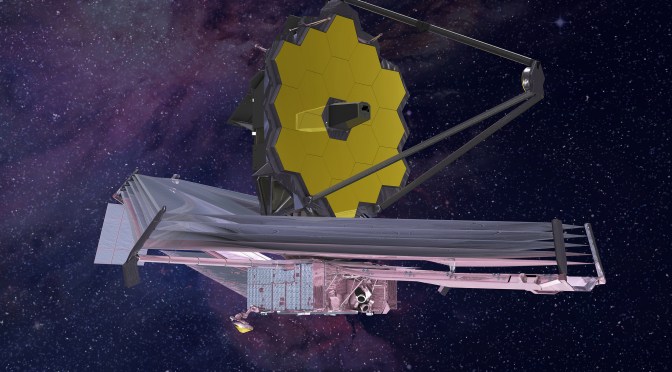
If all goes according to plan, on December 22, a Arianespace rocket will lift off from the European Space Agency’s launch complex in French Guiana. The Webb Telescope will be onboard. This launch and the deploying of the telescope are perhaps the most audacious and risky technological challenges sponsored by NASA since it first sent astronauts to the surface of the moon (and brought them back), conducted the first Space Shuttle launch, and successfully placed the Curiosity Rover on the surface of Mars.

How so, you ask?

This mission aims to park the telescope in a gravitationally stable Lagrange Point (L2) one million miles from Earth. That is something, for sure, but it is by no means the most complex thing to be accomplished on this mission. It’s just the first step.

The telescope and its associated equipment are wrapped-up tight for launch. The package, once at L2, will need to unfold and assemble itself over the span of a month through thousands of mechanical steps that MUST GO ACCORDING TO PLAN — ALL OF THEM! There is no mission redundancy. No room for error. No way to send a repair flight if any of the unfolding and integration processes get gummed up.

All together the starting cost of the mission is $10 billion. Billion.

If it all works out, a successful launch followed by delicate unlatchings, unwindings, unveilings, pivotings and relatching of equipment, then we will have one million miles from Earth a new telescope with a mirror nearly 3-times the size of that on the Hubble Telescope and a field of view (breadth of view) 15-times that of Hubble. It will be capable of viewing infrared light dating back nearly to the beginning of time. The platform will be the size of a tennis court, approximately. On the backside (underneath) of that “court” temperatures will be around 300 degrees F. On the upper (telescope-side) surface of the court, temperatures will be around -300 F. A six-hundred degree difference. If that temperature differential isn’t achieved as planned, well then bollocks!

The package has been tested time and again. Tested in facilities that create a vacuum like that encountered in space. Tested in facilities that ensure the telescope is ready for the shakes and vibrations of launch. Tested in facilities that put the telescope through swings in temperature. The unfolding mechanisms have been run through its paces.

The JPL staff who handle Mars missions talk about the “7 minutes of terror” that come with landing rovers on that planet’s surface — as the vehicle passes through atmospheric entry, begins a fast descent and then lands smoothly. For Webb, buckle up. We are in for weeks of terror (or maybe silent prayers on a frequent basis) as this remarkably complex and complex telescope unfolds and prepares for 5-10 years of operation.

THE VAB is BUZZING @ KSC

It looks like old times — the good kind — at KSC, as the recent spike in activity at the Vehicle Assembly Building is reminiscent of the Shuttle era. This time, it’s the stacking of the Space Launch System (SLS) and Orion capsule that has the high-bays humming as NASA’s own human-rated, heavy-lift vehicle is prepped for a full-up launch. It’s been a long time coming: Artemis I, aiming to send an Orion capsule to the Moon and back.

NASA is saying the flight will commence at Launch Complex 39 no earlier than February 2022, assuming the full-up integration and testing goes as planned. Once more, the Mobile Launch Platform, its massive crawler and Pad 39B will be brought together as the jumping-off point for deep-space flights. Then we’ll cross our fingers as fit-checks are performed, test fueling of the core is conducted and confidence is achieved that vehicle is ready to go.

When Artemis I and the SLS fire-up, we will witness four flight-proven RS-25 main engines — coupled with a pair of solid rocket boosters evolved from Shuttle-times — loft a human-ready spacecraft beyond Earth orbit for the first time since 1972.

While the cadence of SLS launches will not match the pace of Saturn V or Shuttle era flights, Artemis 1 is the harbinger of possibilities to come: deep-space flights, exploration at local LaGrange points and beyond, and the ability to lift the equipment necessary to build complex, multi-component vehicles for extended human spaceflight and stays on the Moon. How SLS might be supplemented by or paired with the capabilities of SpaceX’s Falcon Heavy and Starship are to be determined. But the prospects are exciting and the skies will be the limit no more beginning in 2022. Stay tuned.

2020: When US Crewed Flight Comes back into Focus

In the annals of spaceflight, 2020 likely will be remembered as one of the most significant and transformative moments for U.S. space travel, close behind the initial triumphs of the Apollo-Saturn and Shuttle-ISS programs.  For the first time in this nation’s history, we will see the introduction of two, independently designed and operated means for delivering crews to low Earth orbit. The promise of the commercial crewed flight program will be realized as the United Launch Alliance (ULA) and Boeing bring the Starliner vehicle online and SpaceX lofts its crewed Dragon capsule for the first time.

On the heels of these breakthroughs, NASA continues its Space Launch System (SLS) campaign. It will be exciting to see this massive vehicle enter true, full-up integration and testing on its way to providing the world with a capability it has not had since the early 1970’s: a means to transport astronauts out of Earth’s orbit to destinations as far flung as the Moon, various LaGrange Points and a decade or so from now Mars.

Concurrently, we have Blue Origin and Virgin Galactic getting ready to introduce regular flight options for people with the means and the courage to experience suborbital flight. Sierra Nevada, undaunted by off-again, on-again funding, appears committed to realizing its Dreamchaser “space plane” design as a commercial cargo option for the ISS and other potential destinations in LEO.

SpaceX will continue to build and test its audacious Starhopper proof-of-concept vehicles with the aim of delivering considerable numbers of explorers and colonists to Mars someday.

This diversity of engineering efforts, creativity and outcomes has become the core strength of U.S. spaceflight capabilities. It is something we must sustain and continue to subsidize (for a while longer), if we are to realize the full potential of travel beyond our atmosphere: whether the long-term goals be focused on earth science, space science and astronomy, lunar resource-mining, training for long-duration spaceflight or actual travel to other planets. Our history up to this point has not been one of continuous investment and progress; it’s been more a function of episodic national political, economic and budgetary cycles with uncomfortably long gaps in our ability to send crews skyward. Perhaps these new private-public partnerships will break that pattern, with ULA, SpaceX, Blue Origin and NASA all looking to the stars concurrently with a diverse set of motives.

For fans of spaceflight, 2020 should be a great year for witnessing special events: the launches of crewed Starliner and Dragon, the launch of the Mars 2020 Rover, static-fire testing of the SLS, continuation of the SpaceX Starlink launch campaign, and ULA launching the mighty Delta IV Heavy with NROL missions.

Buckle-up!

Making Space Look Easy

Time and again during launch campaigns, the media representatives for SpaceX remind the public that “Space Is Hard.”   There is no question that spaceflight is immensely complex and full of risks.  That said, SpaceX continues to make spaceflight to Earth orbit seem easier and easier.    The most recent example was this past Tuesday, June 25, at 2:30am when the Falcon Heavy (FH) leapt off Pad 39A and executed what can be described fairly as one of the most complex satellite delivery missions ever:  Space Test Program 2.

For space enthusiasts viewing the launch at KSC or elsewhere down on the Cape, the launch was pure spectacle of the very best kind.   More than 2,500 visitors flocked to the Saturn V Center on Banana Creek with hopes of watching the FH head to orbit (and return) in the middle of the night from the closest vantage point for the general public.   They persisted through a 3-hour wait in the launch window, despite oppressive humidity.    SpaceX and the KSC Visitor Center made the wait all the more worthwhile by providing tunes, pre-launch commentary and catered food.   These FH gatherings provide an important public service, putting children and adults in close contact with what is currently the most audacious and creative spaceflight engineering on the planet.   These are also great and important opportunities for people from around the country (and the globe) with a wide range of perspectives to find and celebrate common ground — a staunch belief in and appreciation of the value of space science and engineering in what is otherwise a fractured political landscape.

At 2:30am, T-minus zero, the 27 Merlin engines on the core and twin boosters fired up and SpaceX once again demonstrated how ingenuity and determination can yield remarkable results including:

  • Launch of a FH using recycled boosters
  • Recovering two of the two boosters on land, adjacent to the launch site
  • Delivering with high-precision 24 satellites across a wide range of orbits
  • Cycling through 4 separate, second-stage burns to get the payload elements to the right  orbits
  • Almost succeeding in a Hail Mary recovery of the first-stage core hundreds of miles out to sea.
  • Catching part of the payload fairing at night

Simply put, the night launch of the FH was beautiful.

Once the FH cleared the pad and headed East, the sky was marked by a stunning, fast-moving, tear-drop of red-orange flame.  After a few seconds, the sounds of launch reached the Saturn V Center and viewers were treated to the truly eerie vibrations created by 27 Merlin engines as they throttle up to full thrust.  The sound is akin to dozens of tightly-coiled springs twanging at high-frequency with a deep base vibe underscoring it.   As the FH pushed downrange, from the ground it seems that the vehicle had turned into a meteorite streaking across the sky, looking as if it might be diving down toward the horizon.   During the immediate climb-out, it was possible to see the condensation cloud that washes over the vehicle as it crosses Max Q.  The sky was clear enough that folks on the ground could see with the naked eye:

  • Separation of the side boosters
  • Haunting, gaseous plumes created by the booster pitch-around and burn-back manuevers
  • Cutoff of the Merlin engines on the center core
  • The concurrent, high-altitude deceleration burns of the side boosters heading back to the Cape
  • The landing burns of the side boosters

No one was disappointed.  I suspect the United States Air Force, the prime sponsor of this mission, was equally satisfied with the outcome for it now has another, economical and reliable flight-proven option for getting various payloads to orbit.

Space is hard but it appears to be getting easier.

Heavy Stuff

Typically, I don’t tack commentary on top of previously published commentary, but what we witnessed with the Falcon Heavy launch was not typical.  It was revolutionary — and solid evidence that true (not subsidized) commercial spaceflight is right around the corner.  It is also evidence that we better believe Elon Musk when he says SpaceX is going to build a BFR for deep-space passenger and cargo loads.

Unless you have been living under a rock, we all saw what SpaceX and Falcon Heavy accomplished.  Succesful, stand-up (first-time) launch of a new vehicle.  Successful, simultaneous return-to-launch-site of two (previously flown) boosters.  A nearly successful return of the core first-stage (…missed it by that much).  Successful fairing deploy.  Successful orbit and orbital-escape burns for one of the most unique payloads ever.

Damn!

If you were down on the Cape to see the Heavy go, you experienced one of the most energizing and optimism-fueling events in spaceflight since Atlantis made its final reach for the stars in 2011.  It was a party atmosphere — and SpaceX and Delaware North (the outsourced operator of KSC visitor sites) proved they know how to throw a party.  At the Saturn V center there was champagne.  Champagne flutes.  Delicious and endless empanadas, egg rolls, stir-fry, pasta and ice cream.  Bill Nye the Science Guy was onsite, narrating the event and talking up science literacy!  The crowd was representative of the U.S.:  blue, red, purple, from all part of the nation.  People who travelled 10-20-200-500-1000-and-3000 miles to bear witness.  “Make American Great Again” hat-wearers  right next to climate scientists.

We have in Falcon Heavy the backup we will need if SLS/Orion is further drawn out or cancelled (please, no)!  It is the bridge to BFR (assuming we can find a safe location from which to launch it).  It is evidence that the genius and vision that led to something as remarkable (and complex) as the Space Shuttle lives on.

HERE WE GO!  The SpaceX Falcon Heavy is at Pad 39A down on the Cape, ready to fly.  This moment has been a long-time coming and by that I mean the return of boosters truly capable of sending astronauts Beyond Earth Orbit (BEO).  The last U.S. rocket capable of doing that was the Saturn V that lofted Skylab in 1973.  NASA continues work on its next human-rated, heavy lift (“deep” space exploration) rocket — the SLS.  If we are lucky, we might see SLS and the Orion capsule launch astronauts beyond Earth orbit in 2023.  The trickle of funding that has barely kept the SLS\Orion alive is at constant risk of reduction or deletion.  At best, I think it’s 50-50 that SLS gets beyond its initial exploratory mission.  Kinda like the Energia system that launched the USSR’s shuttle.  As a nation, we won’t be able to afford it — or have the will to sustain it.

Falcon Heavy could be the vehicle that fills the gap between now and when SLS\Orion flies.  Or it may simply by default become the only option we are going to have for supporting human BEO missions for a long time to come.  SpaceX will need customers — and human-rated qualification for the Heavy and whatever capsule (Dragon Crew, presumably) it puts on top of the Heavy’s core booster — if it is going to ramp-up production of the Heavy and fine-tine it for human spaceflight.  Wouldn’t it be great if NASA considered using the Falcon Heavy for some of its science and exploratory missions?   Despite all the skepticism about commercial cargo and commercial crew, for-profit companies have achieved substantial leaps and bounds in the development of new flight hardware — yes, some very much derived from the Saturn program and, yes, very much funded by government agencies, a.k.a., customers.

With the coming launch of Falcon Heavy, for the first time since I was a grade-schooler, I really believe I will live to see human’s return to the moon.  Let’s see (and hope for) a nice, clean flight this coming week!

SpaceX-pletive Deleted

This week’s loss of a Falcon 9-FT (full-thrust version) on the pad at Cape Canaveral creates real problems for NASA and the ISS.  The vehicle exploded during fueling for a static-firing test of the 9 first stage engines, a dress-rehearsal in preparation for the actual launch of the rocket a few days later.  Rockets exploding during fueling is something that really shouldn’t happen these days, especially when the vehicle involved is supposed to be human-rated (safe for crewed flight),  lofting people into low earth orbit beginning in 2018.

The Xplosion on the pad points to: human error, a problem with the design and/or metallurgy of one or more fuel tanks and/or a problem with the design and mechanics of the fuel-loading system.  This is the second time in less than two years that a Falcon 9 has blown its top due to a problem with the fuel system.  The first time around, poorly manufactured steel struts caused a fuel tank component to break free in mid-flight, puncturing one of the fuel tanks and destroying the vehicle.  The Falcon 9 is supposed to begin bringing crewed Dragon capsules to ISS in the not-too-distant future and is supposed to be the part of the core of the Falcon Super Heavy vehicle that SpaceX will test in 2017.

A lot rides on finding and fixing the latest fault.  SpaceX had recently convinced the US Air Force that the Falcon is reliable and inexpensive enough for national security payloads.  As we heard just yesterday, SpaceX has given the USAF a seat at the investigative table.  How and when NASA grants the vehicle a human-safety rating will be interesting to see.  Right now, the launch vehicle has a potential failure rate (on pad and in-flight) much worse than the retired Space Shuttle.   In the meantime, Boeing and NASA are continuing to prepare vehicles for human-rated low earth orbit (and beyond in NASA’s case) for liftoff in 2018.

Taking a broad perspective on this, here’s a question:  “how do the Russians do it?”  It being highly-reliable human space flight.   Flight after flight of Soyuz “taxis” lofted into low earth orbit for decades to the Salyut station

, then the Mir and now the ISS without substantial fault or failure.  Obviously, the Soyuz technology has developed incrementally over a remarkably long period of time while SpaceX, Blue Origins, Orbital ATK and Virgin Galactic have put forward new designs and capabilities engineered from the ground-up (mostly).  I wonder if engineers at these firms ever could invite their Russian counterparts to sit at the table during failure analyses.  The transfer of knowledge and experience surely would be interesting.

In the meantime, it’s now 6 years since NASA and the U.S. ditched the shuttle.  If we are lucky, we may regain a human spaceflight capability in two more years.  Fingers-crossed.